
Lainesmead Primary School and NurseryStrive, Achieve, Excel; Believe in a Limitless Future.
Performance Data and Strategic Priorities
Performance Data and School Improvement Priorities
Lainesmead Primary School and Nursery
Our Commitment
At Lainesmead, we are committed to ensuring that every child makes strong progress from their starting point. Our outcomes reflect our continued drive to improve provision across the school, particularly in Mathematics.
The data below shows our most recent validated results alongside national comparisons.
Early Years Foundation Stage (EYFS) 2025
Measure | School | National |
Good Level of Development (GLD) | 63% | 70% |
In 2025, 63% of children achieved a Good Level of Development. This cohort followed a reduction in the school’s Published Admission Number (PAN). Outcomes are now based on a smaller cohort following the reduction in PAN from 60 to 30, meaning individual pupils have a greater proportional impact on overall percentages.
Leaders continue to prioritise early language development, phonics and number fluency to ensure children are exceptionally well prepared for Year 1.
Year 1 Phonics Screening Check 2025
Measure | School | National |
Met expected standard | 72% | 80% |
Phonics outcomes improved by 1 percentage point compared to the previous year. While still below national, this reflects continued strengthening of early reading provision. Early identification, targeted intervention and consistent delivery of the phonics programme remain key priorities.
Year 4 Multiplication Tables Check (MTC)
Measure | School | National |
Average Score (out of 25) | 16 | 21 |
7 pupils achieved full marks (25/25)
Mastering Number is now embedded in EYFS and KS1, with full rollout across KS2 underway to strengthen number fluency and long-term mathematical confidence.
Key Stage 2 Results 2025 (Cohort: 60 pupils)
Expected Standard (EXS+)
Measure | School | National |
Reading | 62% | 75% |
Writing | 68% | 72% |
Maths | 50% | 74% |
Reading, Writing & Maths Combined | 35% | 62% |
Higher Standard (Greater Depth)
Measure | School | National |
Reading | 18% | 28% |
Writing | 2% | 13% |
Maths | 10% | 24% |
RWM Combined | 0% | 8% |
Notably, Greater Depth outcomes improved across all subjects compared to 2024.
Average Scaled Scores
Measure | School | National |
Reading | 101 | 105 |
Maths | 100 | 104 |
Understanding Our Context
Our 2025 cohort reflects the complexity outlined in our Inspection Data Summary Report:
- 27% SEN (above national average)
- 40% EAL (around double national)
- 25% Pupil Premium
- 28% joined after Reception
- 8 pupils joined during KS2
Cohort Overview
The cohort included pupils who joined the school at different stages of their education. Pupils who joined in Nursery/Reception achieved:
- 69% EXS+ in Reading
- 72% EXS+ in Writing
- 56% EXS+ in Maths
What the data shows
Strengths
- Greater Depth improved across all subjects.
- Internal tracking shows that 82% of pupils made expected or better progress in Reading and Writing from their starting points.
- Internal tracking shows all SEN pupils made expected progress in Reading.
Key Area for Improvement: Mathematics
Mathematics remains a key priority. Leaders have identified reasoning, problem-solving and consistent challenge as areas for continued development. Work is underway to strengthen number fluency, secure progression across Key Stage 2 and ensure all pupils are fully prepared for end of Key Stage 2 expectations.
Attendance and its Impact
Regular attendance is essential for strong academic progress and pupil wellbeing. Improving attendance, particularly for vulnerable pupils, remains a key priority for the school.
We continue to strengthen early intervention, family engagement and monitoring systems to ensure all pupils benefit from consistent access to learning.
The Department of Education’s page on Lainesmead can be accessed: Lainesmead Primary School
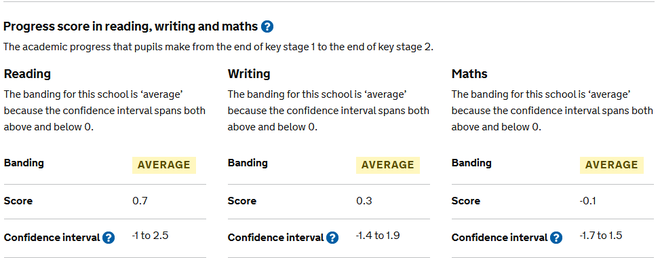
Progress measures
(2022 – Last Published National Progress Scores)
All subjects were banded ‘Average’, meaning pupils made progress broadly in line with pupils nationally with similar starting points.
Key Terms Explained
- Expected Standard: A level of achievement that pupils are expected to reach by the end of KS2.
- Higher Standard: Performance above the expected standard, often requiring greater depth and understanding.
- Progress Scores: Measure how much progress pupils at the school made compared to pupils nationally with similar prior attainment.
- Positive Score: Pupils made more progress than expected.
- Negative Score: Pupils made less progress than expected (though this doesn’t always indicate poor teaching).
For more details about our school’s performance, please visit our page on the Compare School Performance website.
Our Strategic Priorities 2025–26
In response to our 2025 outcomes, internal quality assurance review and ongoing self-evaluation, our key priorities for this academic year are:
1️⃣ Embedding Oracy Across the Curriculum
Strengthening structured talk, vocabulary development and reasoning to improve communication, writing and mathematical thinking across all year groups.
2️⃣ Developing Pace and Challenge in Mathematics
Raising attainment in maths through improved reasoning, consistent challenge, and strengthened number fluency (including full implementation of Mastering Number).
3️⃣ Raising Attainment in Writing
Improving writing outcomes across the school, particularly for disadvantaged pupils, through consistent implementation of the Lainesmead Writing Process and strengthened teacher assessment accuracy.
4️⃣ Strengthening Inclusive Teaching for SEND
Ensuring all classrooms provide confident, adaptive teaching so pupils with SEND make strong progress, particularly in writing and maths.
5️⃣ Raising the Profile and Quality of Science
Securing consistent, high-quality science teaching across all classes and improving pupil engagement and subject leadership.
6️⃣ Strengthening EYFS Foundations Across Subjects
Improving subject leaders’ understanding of early years pedagogy to ensure strong curriculum progression from Nursery through to Year 6.
7️⃣ Expanding “Real Life, Real Learning”
Increasing meaningful real-world links in lessons and enrichment opportunities to enhance relevance, aspiration and cultural capital.
8️⃣ Supporting Transition from KS1 to KS2
Ensuring strong outcomes at the end of Key Stage 1 are sustained into Year 3 and beyond through structured bridge provision and consistent expectations.
9️⃣ Reducing Persistent Absence
Reducing persistent absence to below 15%, with a particular focus on disadvantaged and SEND pupils, to secure equitable access to learning.