Lainesmead Primary School and NurseryStrive, Achieve, Excel; Believe in a Limitless Future.
Keeping You Safe!
Keeping You Safe
Your Voice Matters : Speak out. Be heard. Be safe.
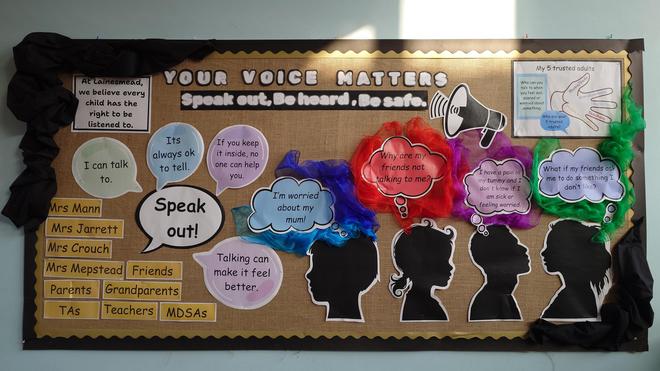
At Lainesmead, there are grown-ups who are here to help you feel safe, happy and looked after.
If something feels wrong, confusing, scary or upsetting — you can always talk to us.
You will not get in trouble for telling.
�� Worried about something?
You might feel:
- �� Worried
- �� Unsafe
- �� Sad
- �� Cross
- �� Confused
- �� Or like something just doesn’t feel right
That feeling is important.
Your body sometimes gives you clues — like a wobbly tummy, tears, feeling shaky, or wanting to hide.
If you feel like that, it’s time to tell a trusted adult.
�� What is a Trusted Adult?
A trusted adult is:
- A grown-up who helps keep you safe
- Someone who listens to you
- Someone who takes your worries seriously
- Someone who helps you feel calm and protected
Trust means believing someone will listen, help you, and keep you safe.
✋ My Trusted Hand
Every child at Lainesmead creates a Trusted Hand.
Each finger is a person you can talk to when you need help.
Your Trusted Adults might be:
- A teacher
- A teaching assistant
- The Headteacher
- A parent or carer
- A grandparent
- A lunchtime supervisor
- A club leader
- Another safe grown-up in your life
You can have different trusted adults at home, at school, and in other places.
And your Trusted Hand can change as you grow.
�� What if something feels unsafe?
Unsafe means:
- Something feels wrong
- Someone makes you feel scared or uncomfortable
- You are asked to keep a secret that makes you feel bad
- Someone hurts your body or your feelings
- Someone keeps being unkind again and again
If that happens:
�� Tell the Headteacher
�� Or talk to any trusted adult
It is always okay to tell someone.
�� Secrets and Surprises
There is a difference between a surprise and a secret.
�� A surprise is happy and gets told soon.
�� A secret that makes you feel sad, scared or confused should always be told.
If someone says:
“Don’t tell.”
“You’ll get in trouble.”
“Don’t be a snitch.”
Remember:
Speaking up to keep yourself or someone else safe is not snitching.
It is brave.
�� How do I ask for help?
You could say:
- “Can I talk to you?”
- “I feel worried.”
- “Something happened.”
- “I need help.”
- “I don’t feel safe.”
If talking feels hard, you can:
- Write a note
- Ask a friend to come with you
- Show your Trusted Hand
- Tell a different adult
Keep telling until someone listens.
�� Staying Safe Online
When you are online:
✔ Send kind messages
✔ Tell an adult if something upsets you
✔ Ask before downloading games or apps
Never:
❌ Share your password
❌ Share personal information
❌ Keep unkind online messages secret
If something online makes you feel worried, sad or uncomfortable — tell a trusted adult.
�� If you see someone else being hurt
If you notice:
- Someone being left out every day
- Someone being called names again and again
- Someone looking sad or scared
- Someone being hurt on purpose
You can:
✔ Tell a trusted adult
✔ Help them walk away
✔ Sit with them
✔ Be kind
Bystanders can make a big difference.
�� Remember
- Bullying is repeated and unfair.
- Unkind behaviour can happen once.
- It is never your fault if someone hurts you.
- You deserve to feel safe.
- We will always listen.
�� Say it with us
“I am not a snitch — I am brave.
I speak up because I care.
I can talk. I can tell. I will be heard.”
Need more help?
If you cannot talk to someone in school, you can also contact:
�� Childline – 0800 1111
�� NSPCC
�� ThinkUKnow